If you're self-employed and plan to buy, refinance or switch lenders in 2027, the expenses you claim for 2026 will shape how much you can borrow. Most lenders qualify you on the net income shown on your tax return, not your sales, so every extra write-off that cuts your tax also cuts your approval. December is when you can still decide how to balance the two.
Why your tax return is your mortgage application
When you're salaried, a lender looks at your pay stub. When you're self-employed, the lender looks at what you reported to the CRA. For a CMHC-insured mortgage, CMHC lists a Notice of Assessment with the T1 General and your statement of business activities (form T2125) as income documents, and it recommends at least 24 months in business or in the same line of work.
In my experience, most mainstream lenders average your last two years. So a lean 2026 doesn't just affect next year; it drags down the average you'll be judged on until it rolls off.
There is some help built in. CMHC says that for sole proprietors and partnerships, self-employed income "may be grossed up by 15%," or the lender can add back eligible deductions instead. Not every lender or insurer treats income the same way, which is one reason it pays to know the rules before you file, not after.
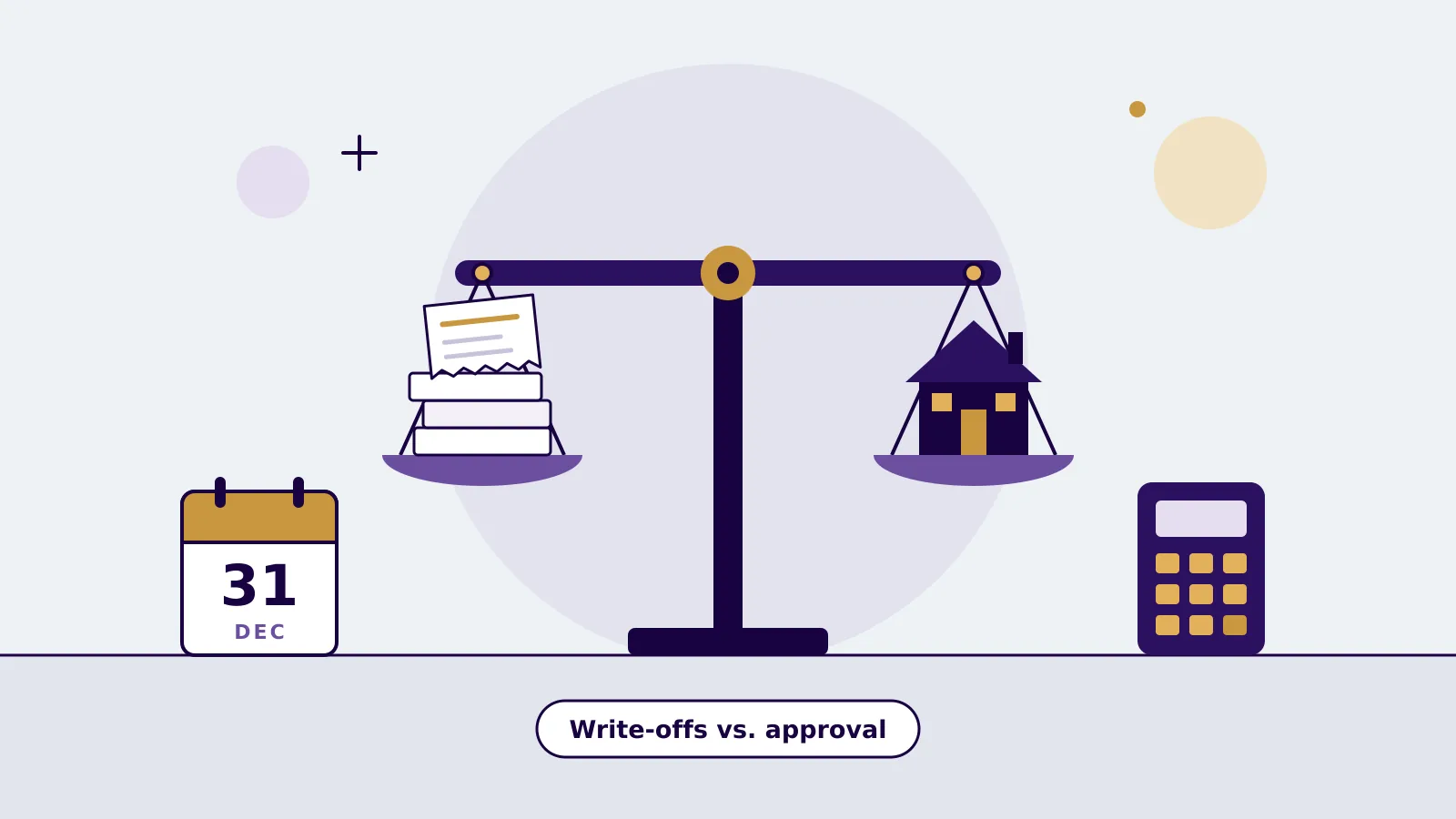
Which year-end moves affect approval, and which don't
- Extra business expenses lower your approval. Buying equipment early, a bigger vehicle claim or a larger home-office share all reduce the net business income on your T2125, which is the number most lenders start from.
- RRSP contributions generally don't. An RRSP contribution is a personal deduction claimed on line 20800 of your return, not a business expense, so it lowers your tax without lowering your business income. The CRA's deadline for 2026 contributions is March 1, 2027.
- Some deductions can be added back. Depending on the lender, non-cash items such as capital cost allowance may be added back to your income. Ask before you assume it will help you.
- Unpaid tax can stop a deal. In my experience, lenders want to see that the CRA has been paid in full. For the 2026 tax year, the CRA says the self-employed filing deadline is June 15, 2027, but any balance owing is due April 30, 2027.
An Ontario example: the cost of an extra $20,000 write-off
The scenario: A self-employed sole proprietor in the GTA reported $90,000 of net business income for 2025. For 2026, they can either report another $90,000, or claim an extra $20,000 of discretionary expenses and report $70,000. They want a CMHC-insured purchase in 2027, and the lender averages two years and uses CMHC's 15% gross-up.
| Report $90,000 for 2026 | Report $70,000 for 2026 | |
|---|---|---|
| Two-year average income | $90,000 | $80,000 |
| Income after 15% gross-up | $103,500 | $92,000 |
| Maximum housing costs at 39% GDS | about $3,364 a month | about $2,990 a month |
| Maximum mortgage, qualified at 6.49% | about $425,400 | about $369,600 |
| Actual payment at an assumed 4.49% | about $2,352 | about $2,044 |
Calculation basis: 25-year amortization (CMHC's maximum for its self-employed product), monthly payments, Canadian semi-annual compounding. Assumed property tax of $5,000 a year and heating of $100 a month; no other debts, which would also be tested against CMHC's 44% TDS limit. The 4.49% 5-year fixed rate is an assumption, not an offer; the qualifying rate is the greater of the contract rate plus 2% or 5.25%. Lenders differ in how they average, gross up or add back income. Illustrative only, OAC.
On these assumptions, the $20,000 write-off reduces the maximum mortgage by about $55,800. Whether that trade is worth it depends on what the write-off actually saves in tax, and that's a question for your accountant. My point is that it should be a decision, not something you discover when a lender reads your Notice of Assessment.
Who this affects
- Sole proprietors and contractors planning to buy in 2027, including first-time buyers.
- Self-employed homeowners renewing or refinancing next year. If you're only moving your mortgage at renewal, a straight switch may avoid requalifying, but a refinance needs full income.
- Incorporated owners deciding between salary and dividends, since what lands on your personal return is usually what a lender can use.
- Newer businesses with less than two years of returns, who may need a different lender or product.
What to do now
- Before December 31, talk to your accountant and to me in the same week. Bring your 2025 Notice of Assessment and a year-to-date estimate for 2026.
- Decide on your target income for 2026, knowing roughly what each dollar of write-off costs in borrowing power.
- Use RRSP room for tax savings where it suits you, instead of discretionary business expenses that reduce qualifying income.
- Pay any balance owing by April 30, 2027, and keep instalments current. A tax debt can hold up an approval.
- Get a pre-approval early in 2027 once your return is assessed. Watch the December 9 Bank of Canada decision too, since rates feed straight into the qualifying math.
If your income on paper doesn't match what your business really earns, there are lenders with programs built for that, and private options for short-term needs. Tell me about your business and your 2027 plans and I'll show you how lenders are likely to read your numbers before you file.
Information current as of November 27, 2026; rates and rules change. This article is general information, not tax advice.
Sources
- CMHC: Self-Employed mortgage loan insurance (documents, 15% gross-up, 25-year maximum amortization; accessed November 27, 2026)
- CMHC: Calculating GDS / TDS (39% GDS and 44% TDS limits; accessed November 27, 2026)
- OSFI: Minimum qualifying rate for uninsured mortgages (modified January 29, 2026; accessed November 27, 2026)
- Government of Canada: 2027 tax deadlines for businesses and self-employed individuals (modified October 16, 2026; accessed November 27, 2026)
- CRA: Important dates for RRSPs and more (modified November 17, 2026; accessed November 27, 2026)
- CRA: How to claim your RRSP contributions (line 20800; modified September 17, 2026; accessed November 27, 2026)