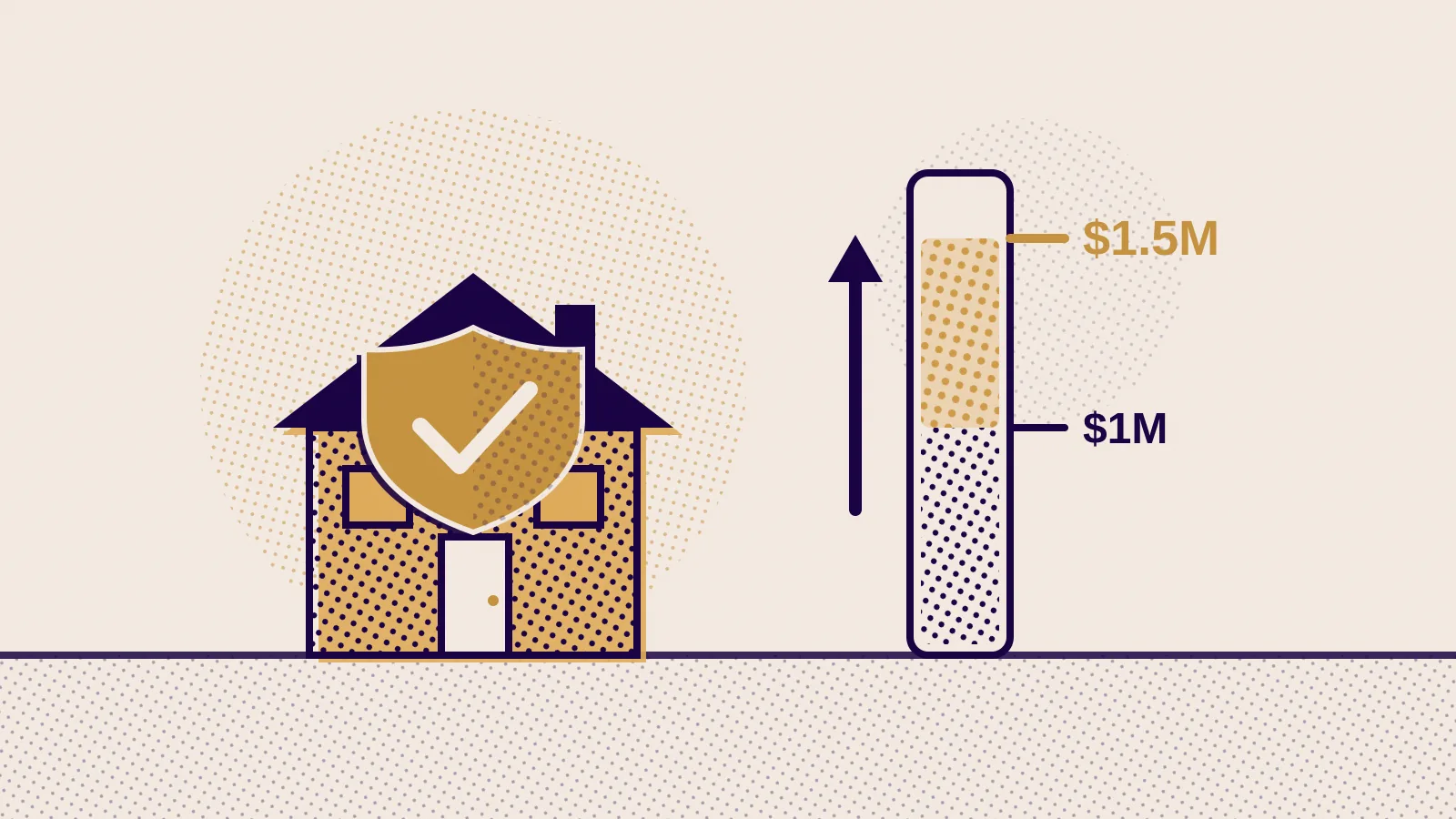
If you're buying a home between $1 million and $1.5 million with 20% or more down, your mortgage can't be insured today, even optionally. Budget 2026 proposes to change that: it would raise the price limit for optional mortgage insurance from $1 million to $1.5 million, and allow 30-year amortizations on these insured mortgages when at least one borrower is a first-time buyer or the home is newly built. It's a proposal with no start date yet, but in the GTA it touches a big slice of the market.
What the budget actually proposes
The federal budget, released November 5, 2026, lists four mortgage measures under "Helping Canadians get an affordable mortgage." The one I want to focus on is the optional insurance change:
- Price limit: optional mortgage insurance would be available on homes up to $1.5 million, up from $1 million.
- Amortization: these insured mortgages could run 30 years, provided at least one borrower is a first-time home buyer or the home is newly built.
- Why: the government says the changes would "encourage greater competition between lenders."
- Timing: no effective date has been announced. Until the rules are finalized, nothing changes for today's buyers.
For context, the $1.5 million cap already applies to buyers putting down less than 20%. That changed on December 15, 2024, the same day 30-year amortizations opened up to all first-time buyers and buyers of new builds. This proposal would bring the 20%-down side in line.
What "optional" insurance means for you
With less than 20% down, mortgage insurance is mandatory and you pay the premium. With 20% or more down, insurance isn't required. But a lender can still choose to insure the loan, usually at its own cost, because an insured mortgage is cheaper for the lender to fund.
Here's why that matters to you. In my experience, lenders tend to price mortgages that can be insured more sharply than ones that can't. Right now, a 20%-down purchase at $1,050,000 or $1,400,000 falls into the "can't be insured" bucket, so it's often priced as an uninsured mortgage. If this proposal goes ahead, many of those files would move into the insurable bucket, which is exactly the competition the budget is talking about.
I won't promise a specific rate difference. It varies by lender, by week and by file. But on a mortgage this size, small differences add up fast.
Why the GTA should pay attention
According to TRREB, 1,304 of the 5,603 GTA home sales in October 2026 were priced between $1,000,000 and $1,499,999. That's about 23% of the market, all above today's optional insurance limit and below the proposed one.
The same report put the average City of Toronto semi-detached price at $1,225,229 and the average detached home in the 905 regions at $1,199,303. Those are the homes this change is aimed at: family homes that move-up buyers and well-saved first-time buyers are shopping for.
A Toronto example with real numbers
Say you buy a $1,225,000 semi in Toronto with 20% down ($245,000). Your mortgage is $980,000.
| 25-year amortization | 30-year amortization | |
|---|---|---|
| Monthly payment at 4.50% | $5,424.03 | $4,941.31 |
| Payment used to qualify at 6.50% | $6,564.27 | $6,138.74 |
Two things stand out. First, every 0.10% of rate on this mortgage is worth about $54 a month on a 25-year amortization, or roughly $3,260 in payments over a five-year term. That's why better pricing on insurable files matters. Second, if you're a first-time buyer, the 30-year option lowers the payment you have to qualify for by about $426 a month, which can make the difference on a tight file.
Calculation basis: Canadian semi-annual compounding, monthly payments. The $1,225,000 price and 4.50% rate are assumptions for illustration, not quotes or offers. The 6.50% qualifying rate is the contract rate plus 2%, which is above the 5.25% floor. Excludes property tax, heat and land transfer tax. Rates are on approved credit (OAC) and subject to change. Illustrative only.
One honest note: many lenders already offer 30-year amortizations on uninsured mortgages, so the 30-year piece isn't brand new for 20%-down buyers. What would be new is getting it on an insurable mortgage, with the pricing that can come with that. A longer amortization also means more interest over time. My guide to longer amortizations walks through that trade-off.
Who this affects
- First-time buyers with 20%+ saved, shopping between $1M and $1.5M: the biggest potential winners, since both the insurability and the 30-year option would apply.
- Buyers of newly built homes in that range: same two benefits, whether or not you've owned before.
- Move-up buyers on resale homes: the price limit would help, but the 30-year insured option wouldn't apply unless a co-borrower is a first-time buyer.
- Homes over $1.5 million: no change. Those mortgages stay uninsured.
What to do now
- Don't wait on a proposal. There's no start date. If the right home comes up, buy on today's rules and today's pricing.
- Get pre-approved on both scenarios. A mortgage pre-approval shows what you qualify for at 25 and 30 years, so you know what the change would add.
- Check your first-time buyer status. If you or a co-borrower may count as a first-time buyer, it affects your amortization options now and later. Our first-time home buyer page covers the programs, and my post on Toronto land transfer tax for first-time buyers shows the closing costs to budget for.
- Compare more than the rate. On a $1M mortgage, prepayment privileges and penalty terms matter as much as a few basis points. The budget also flags a consultation on prepayment penalty transparency for insured mortgages.
If you're buying in the $1 million to $1.5 million range and want to see how this would change your numbers, talk to our Toronto mortgage broker team and I'll run both scenarios with you.
Information current as of November 21, 2026; rates and rules change. This is a budget proposal; the final rules, start date and lender policies had not been published at the time of writing.
Sources
- Budget 2026, Chapter 3: A more affordable life (November 5, 2026; accessed November 21, 2026)
- Department of Finance Canada: Budget 2026 Key Measures (November 5, 2026; accessed November 21, 2026)
- Department of Finance Canada: mortgage reforms in force December 15, 2024 (December 15, 2024; accessed November 21, 2026)
- TRREB Market Watch, October 2026 (November 4, 2026; accessed November 21, 2026)