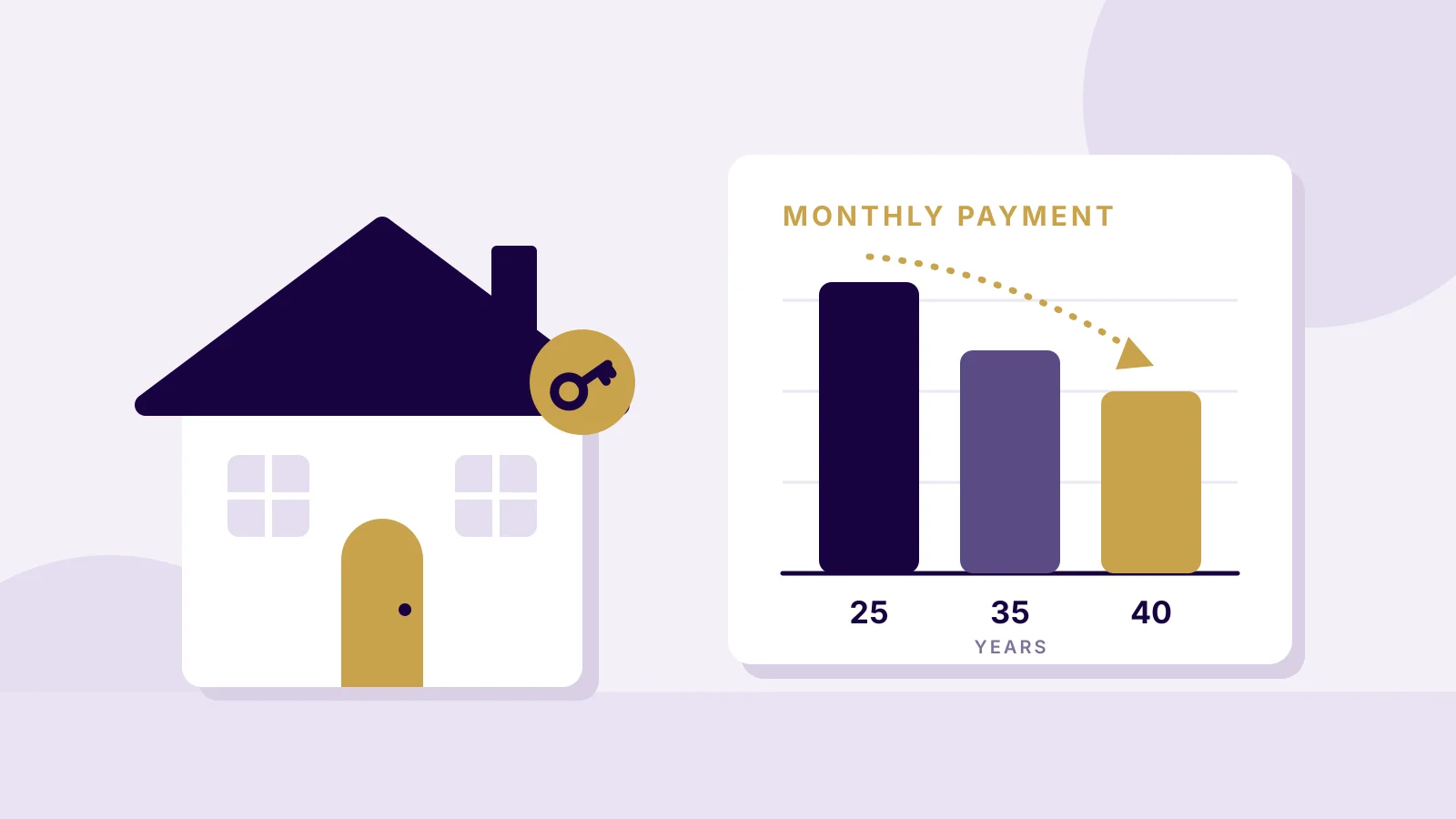
If your income and down payment are solid but the numbers come up just short, a longer amortization may be the fix. Stretching a mortgage over 35 or 40 years lowers your monthly payment, and a lower payment can be exactly what helps you qualify for the home you want. For qualified borrowers with a conventional mortgage (20% or more down), we offer both 35-year and 40-year amortizations.
Here's how it works, what it takes today, and what it costs, side by side.
What is mortgage amortization?
Your amortization is the total time it will take to pay off your mortgage in full. It's different from your term, which is the length of your current contract with the lender (usually 1 to 5 years). You might have a 3-year term on a 35-year amortization, for example, and renew several times along the way.
Who can get a 35- or 40-year amortization in Canada?
Extended amortizations are for conventional mortgages only: 20% or more down (or 20% equity on a refinance), with no mortgage default insurance. Insured mortgages can't go past 30 years at all, and most banks and prime lenders cap a conventional mortgage at 30 years. Beyond that, 35 and 40 years come from select alternative lenders, which is where a broker comes in.
How a longer amortization helps you qualify
Lenders decide how much you can borrow by looking at what share of your income goes toward housing costs and debts. Your mortgage payment is the biggest piece of that calculation. When you spread the same loan over more years, each payment gets smaller, which leaves more room within the lender's limits. That room can be the difference between "almost" and "approved."
How much room depends on the rate you're tested at. Most options are tested at the contract rate plus 2% (the stress test). Some 40-year programs qualify you at the contract rate itself.
Here's an illustration using conventional mortgage rates as of October 2026. Say your income and debts leave room for a qualifying payment of about $3,500 a month:
| Amortization (rate) | Rate it's tested at | Approximate maximum mortgage |
|---|---|---|
| 25 years (4.59%) | 6.59% (rate + 2%) | $518,000 |
| 30 years (4.84%) | 6.84% (rate + 2%) | $540,000 |
| 35 years (5.24%) | 7.24% (rate + 2%) | $540,000 |
| 40 years (5.49%) | 5.49% (contract rate, no +2%) | $685,000 |
When the stress test applies, 35 years adds almost no room over 30, because its higher rate offsets the longer amortization. Its real lift comes from the higher debt-ratio limits those lenders allow. The biggest jump comes from 40-year programs that qualify you at your actual rate.
35-year amortization: lower payments, more flexibility
For qualified borrowers, a 35-year amortization can ease your monthly budget and boost your buying power. It's a good fit if you:
- Are close to qualifying and need modest breathing room
- Want a more comfortable monthly payment while you settle into a new home, start a family or grow your career
- Plan to make extra payments when you can, but want a lower required payment as a safety net
What a 35-year mortgage takes today
- At least 20% down (or 20% equity on a refinance)
- A credit score of about 600 or higher
- Short-term mortgages only: 1- to 3-year fixed terms, with rates as of October 2026 starting around 5.2% to 5.4%
- A lender fee of up to about 1.5%
- Debt-ratio limits well above bank levels, though most of these lenders still apply the stress test
40-year amortization: when you need that extra push
Yes, we offer 40-year amortization. When a few more dollars of room makes the difference, it can help you qualify. A 40-year amortization gives you the lowest regular payment of any option. It can make sense if you:
- Are buying in a high-priced market like the GTA, where every dollar of qualifying room counts
- Are self-employed or have income that's strong but uneven, and want a lower fixed obligation
- Expect your income to rise and plan to shorten your amortization later through prepayments or at renewal
What a 40-year mortgage takes today
- At least 20% down (or 20% equity), with a loan of $200,000 or more
- A credit score of about 620 or higher (around 700 for rental properties)
- Short-term mortgages only: 1- or 2-year fixed terms, with rates as of October 2026 around 5.3% to 5.9% depending on credit and down payment
- A lender fee of about 2%, and higher penalties if you pay the mortgage out in the first two years
- Qualification at your actual contract rate in some programs, with debt ratios up to 55%
The trade-off: lower payments vs. more interest
A longer amortization means a lower payment, but more interest over time. You deserve to see both sides before you decide. Here's how the numbers compare on a $600,000 mortgage at conventional mortgage rates as of October 2026:
| Amortization | Rate | Monthly payment | Total interest paid |
|---|---|---|---|
| 25 years | 4.59% | $3,351 | $405,300 |
| 30 years | 4.84% | $3,145 | $532,200 |
| 35 years | 5.24% | $3,099 | $701,500 |
| 40 years | 5.49% | $3,065 | $871,400 |
Calculation basis: conventional mortgage rates as of October 2026, semi-annual compounding, rate held constant for the full amortization. Illustrative only, OAC.
Going from 25 to 40 years lowers the payment by about $286 a month and adds roughly $466,100 in interest if you never pay it down faster. Because longer amortizations carry higher rates, the monthly savings shrink while the interest cost grows.
A few other things to keep in mind:
- You build equity more slowly. In the early years, more of each payment goes to interest and less to principal.
- Expect a higher rate and a lender fee. Extended amortizations come from alternative lenders, which typically charge a few tenths of a percent more plus a fee of 1% to 2%.
- It's a short-term mortgage only. A 35- or 40-year amortization is only offered on short terms of 1 to 3 years, not on a 5-year fixed. You'll renew more often and face rate changes sooner.
- Plan your exit. Many borrowers use a long amortization for a few years, then move to a bank. Banks cap amortization at 30 years, so moving usually means a higher payment. We'll map that out with you up front.
You're not locked in forever
A longer amortization sets your minimum payment, not your maximum. Most mortgages let you make lump-sum prepayments or increase your regular payments each year. If your income grows, you can pay the mortgage down faster and cut your total interest significantly, while keeping the safety net of a lower required payment if life gets tight.
Each renewal is also a natural checkpoint to revisit your amortization and shorten it if your situation has improved.
35 and 40-year amortization FAQ
Can you get a 40-year mortgage in Canada?
Yes, on a conventional mortgage with at least 20% down. The big banks stop at 30 years, so 40-year amortizations come from select alternative lenders, on 1- or 2-year terms.
Can I get a 35-year amortization with less than 20% down?
No. Insured mortgages (under 20% down) max out at 30 years, and only for first-time buyers or new builds. A 35- or 40-year amortization requires a conventional mortgage.
Do 35 and 40-year mortgages use the stress test?
It depends on the lender. Most 35-year programs still test you at your rate plus 2%. Some 40-year programs qualify you at your actual contract rate, which is why they add the most buying power.
Can I get a 5-year fixed rate with a 40-year amortization?
Generally no. Extended amortizations are offered on short-term mortgages only, usually 1- to 3-year fixed terms.
Can I shorten my amortization later?
Yes. You can prepay within your mortgage's privileges, raise your payments, or choose a shorter amortization at renewal.
Is a 35 or 40-year amortization right for you?
There's no single "right" amortization. A shorter one saves interest; a longer one makes your payment more manageable and can help you get into the home you want. The best choice depends on your income, your plans and how much flexibility you want in your monthly budget.
That's why we'll always show you both numbers, the monthly payment and the total interest, side by side, so you can make the call with your eyes open. Talk to us about whether a 35- or 40-year amortization is right for you.
Rates and lender requirements are typical of what we're seeing as of October 2026 and change often. Figures are illustrative and assume Canadian semi-annual compounding with a constant rate. Actual rates, fees, terms, availability and qualification depend on the lender and your situation. All mortgages are subject to approval (OAC).