Yes, you can usually finance a legal basement apartment in Brampton, and the rent can help you qualify. The catch is that lenders and insurers only count a suite the City recognizes, so the registration and permit come first, then the money.
Here's how the Brampton rules, the CMHC secondary suite refinance and the qualifying math fit together, with real numbers at today's prices.
What Brampton allows
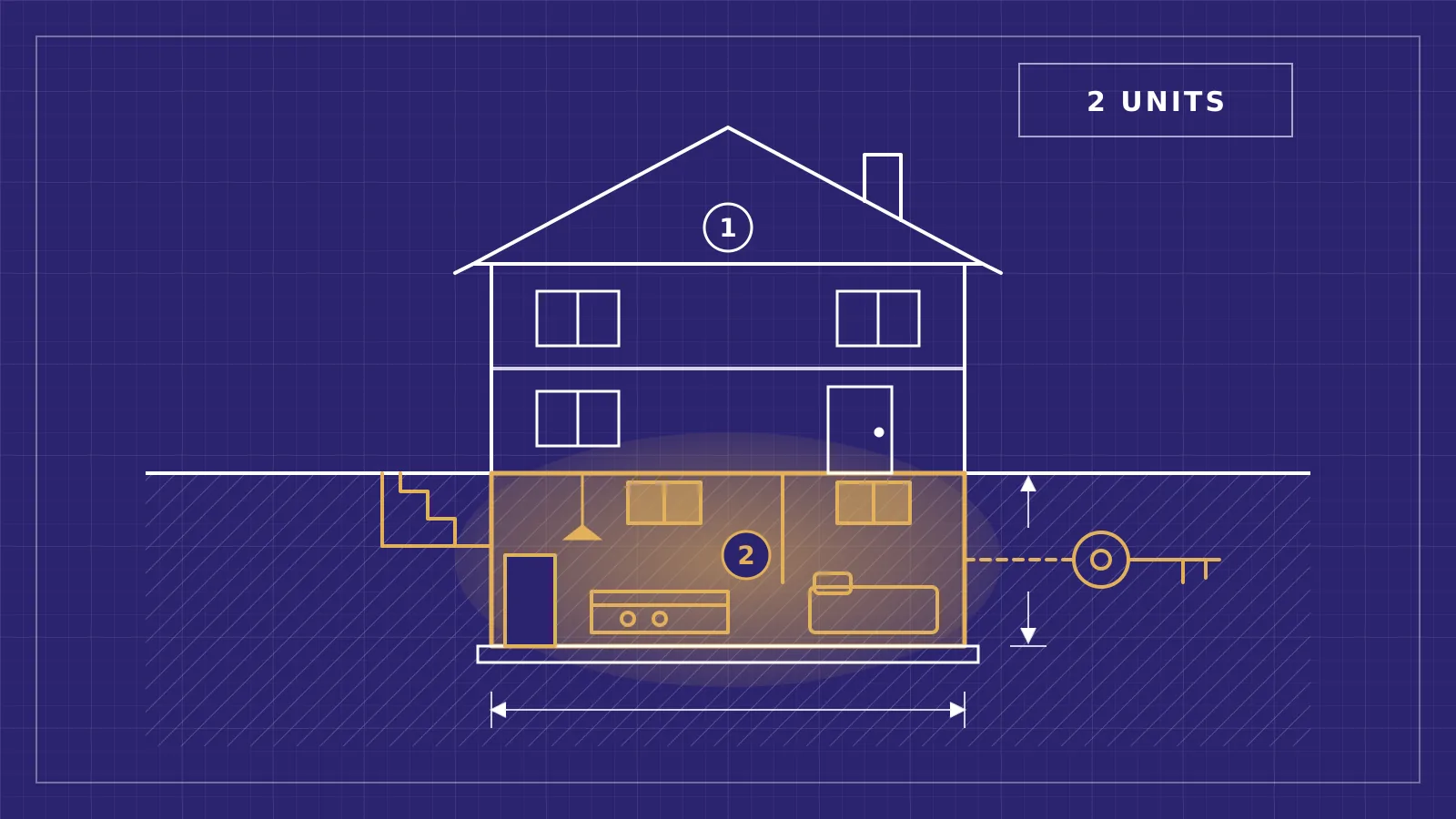
Brampton calls these Additional Residential Units (ARUs). The City's zoning by-law allows up to three units on a property, counting your main home, in one of two combinations:
- your home, one attached second unit (like a basement apartment) and one detached garden suite, or
- your home plus an attached second unit and an attached third unit.
ARUs can go in a detached, semi-detached or townhouse dwelling. No extra parking space is needed for a single second unit or garden suite, but a lot with two ARUs needs one additional space (tandem parking is allowed). ARUs aren't permitted in floodplain areas, open space zones, lodging houses or supportive housing residences.
Registration, licensing and fees
Brampton has three separate requirements, and each one matters to your lender.
- Register the unit. Every ARU goes through a one-time registration and building permit. For a two-unit dwelling, the City lists a $200 registration fee and a $1,186.24 permit fee, followed by mandatory inspections.
- License the rental. Since January 1, 2026, owners of rental properties with one to four units in every Brampton ward need a Residential Rental Licence before advertising, collecting rent or letting anyone move in. A rented ARU needs both registration and a licence. Applications and renewals are currently free, and the licence renews every year.
- Use licensed trades. Brampton requires building renovators, plumbing contractors and HVAC contractors to be licensed by the City before working on an ARU.
Skipping this is costly. The City lists administrative penalties of $1,000 to $1,500 for failing to register an ARU. Building permit information is also shared with MPAC, so your property assessment may change.
From a financing point of view, the paperwork is the asset. A registered, licensed suite is one a lender can appraise and an insurer can count. An unregistered one usually isn't.
The CMHC secondary suite refinance
Normally, a refinance is capped at 80% of your home's value. CMHC's refinance for building secondary suites goes higher for owners who qualify:
- Up to 90% loan-to-value, for properties up to 4 units including yours.
- Based on the as-improved value, meaning the appraised value after the suite is built, which must be below $2,000,000.
- Amortization up to 30 years.
- You (or a family member living there rent-free) must occupy one unit. The suite must be self-contained and can't be rented for less than 90 consecutive days.
- The new money must go to building the suite. No equity take-out.
Funds are usually advanced in stages as construction is verified, so you'll need a plan to pay your contractor between draws. If the 30-year amortization question is new to you, I explained the trade-offs in my post on 35- and 40-year amortizations.
A Brampton example with real numbers
TRREB's October 2026 data puts the Brampton detached benchmark price at $969,800, down 5.42% from a year ago. The average detached sale was $941,016.
Take a hypothetical owner of a detached Brampton home worth about $970,000 with a $760,000 mortgage. They want to spend $145,000 building a legal basement apartment. Assume the appraiser puts the as-improved value at $1,040,000 and estimates rent at $1,900 a month.
| Regular refinance (80%) | CMHC suite refinance (90%) | |
|---|---|---|
| Maximum mortgage | $832,000 | $936,000 |
| New money available | $72,000 | Up to $176,000 (suite costs only) |
| Covers the $145,000 build? | No | Yes: $905,000 total, 87% LTV |
At 87% LTV, CMHC's premium schedule charges the lower of 3.10% on the total loan or 6.25% on the increase, plus 0.20% for a 30-year amortization. Here that works out to about $9,350, added to the mortgage, for a total of about $914,350.
At an illustrative 4.49% rate over 30 years, the payment is about $4,605 a month. The suite's $1,900 rent covers roughly 41% of it.
Now qualifying. Insured mortgages are qualified at the greater of your rate plus 2% or 5.25%, so 6.49% here, which makes the qualifying payment about $5,722 a month. For an owner-occupied two-unit home, CMHC allows up to 100% of the gross rent to be added to your income. To stay within CMHC's 39% GDS limit:
- without the rent, you'd need about $176,050 in household income
- counting the $22,800 a year in rent, you'd need about $153,250
Calculation basis: semi-annual compounding, 30-year amortization, no other debts, principal and interest only (CMHC allows taxes and heat to be excluded under this rental income approach). Rent, value and costs are assumptions. Illustrative only, OAC. Rates, premiums and lender policies change.
Who this affects
- Brampton owners with equity tied up in the house who want rental income but can't reach the money under the 80% limit.
- Multi-generational families who want a separate unit for parents or adult children.
- Owners who already rent out a basement without registration. Your lender may not count that rent, and the City can fine you.
- Buyers looking at homes with an existing suite. Ask whether it's registered before you firm up. It changes what you can borrow.
What to do now
- Check your lot. Brampton's ARU Search Tool gives site-specific information on whether a garden suite or attached unit could work on your property.
- Get a realistic build quote from licensed trades before talking about financing. The quote drives the as-improved value and the loan.
- Talk to a broker before you sign a contract. Not every lender may offer the CMHC suite refinance, and your existing mortgage's penalty matters. Compare it with a HELOC or second mortgage if you have plenty of equity.
- Plan for the draws. Know how you'll fund work between advances.
- Register and license before the first tenant moves in.
If you're in Brampton or elsewhere in Peel, our Peel Region mortgage page covers how we work locally, and my GTA refinance page lays out the other ways to access equity.
Thinking about a basement apartment? Start with a renovation financing review and I'll show you what your home can support before you hire a contractor.
Information current as of November 18, 2026; rates and rules change.
Sources
- City of Brampton: Additional Residential Units (accessed November 18, 2026)
- City of Brampton: Two-Unit Dwelling Registration Process (accessed November 18, 2026)
- City of Brampton: Residential Rental Licensing (accessed November 18, 2026)
- CMHC: Refinance for Building Secondary Suites (accessed November 18, 2026)
- CMHC: Rental income (accessed November 18, 2026)
- CMHC: Calculating GDS/TDS (accessed November 18, 2026)
- TRREB: MLS® Home Price Index, October 2026 and Market Watch, October 2026 (accessed November 18, 2026)